

How Each Approach Actually Works
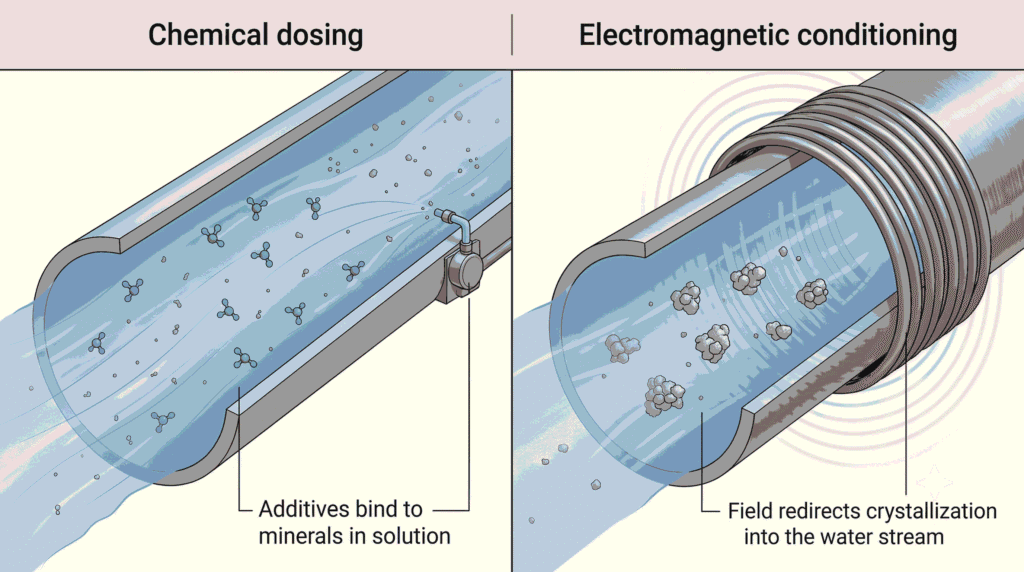
Chemical dosing treats scale as a water chemistry problem to be managed directly. Scale inhibitors — often threshold-active or crystal-modifying compounds — are dosed into the water to interfere chemically with crystal growth, keeping dissolved minerals from binding into hard deposits. Full-service dosing programs typically run scale inhibitors alongside corrosion inhibitors (which form a protective film on metal surfaces) and biocides (which control microbiological growth), all maintained within specific concentration ranges through continuous or periodic dosing, monitored and adjusted against regular water testing.
Electromagnetic conditioning treats scale as a crystallization-location problem rather than a chemistry problem. Instead of adding anything to the water, a pulsed electromagnetic field is applied to the water stream, influencing whether dissolved calcium carbonate crystallizes out in the open water — where it stays suspended and gets carried along with the flow — or directly onto pipe and tube surfaces, where it bonds and hardens into scale. Nothing is removed from or added to the water’s chemical composition; the intervention is physical, not chemical.
Side-by-Side Technical Comparison
Dimension | Chemical Dosing | Electromagnetic Conditioning |
Primary mechanism | Additives alter water chemistry directly (inhibition, film formation) | Pulsed field influences where crystals nucleate, without altering water chemistry |
Typical treatment scope | Often bundles scale, corrosion, and biological control in one program | Generally scoped specifically to scale prevention |
Installation | Dosing pumps and controllers tied into the system; typically requires ongoing infrastructure | Often clamps around existing piping; commonly installed without cutting into the pipe or stopping operation |
Ongoing consumables | Requires regular chemical purchase, storage, and handling | No chemical consumables; runs on electrical power |
Monitoring & maintenance | Requires regular water testing and dosing adjustment to stay within target ranges | Requires correct initial installation (adequate coil coverage) and periodic verification that the unit is operating as installed |
Cost structure | Recurring consumable and service cost that scales with system size and water usage | Largely fixed cost after installation; ongoing cost limited to power draw |
Water discharge consideration | Dosed chemicals are present in blowdown water and may be subject to local discharge/effluent requirements | No chemical additives in blowdown; discharge considerations relate to mineral concentration, not chemical content |
Track record | Long-established, extensively documented across decades of industrial and commercial use | Established engineering principle, but evidence quality varies significantly by specific product and manufacturer |
What Each Approach Actually Addresses
It’s worth being precise about scope, because this is where the two approaches are least alike. A full chemical dosing program is often designed to manage three things at once: scale, corrosion, and microbiological growth. Electromagnetic conditioning, based on the mechanism and published claims available for these technologies, is generally positioned specifically around scale prevention.
That difference matters in practice. A facility with older mild steel infrastructure and meaningful corrosion risk may still value a dosing program’s corrosion-inhibiting function specifically, regardless of how it handles scale. Some facilities run electromagnetic conditioning for scale control while retaining a lighter, targeted dosing program for corrosion or biological control — treating the two as complementary rather than mutually exclusive. Understanding this scope difference up front avoids the mismatch of expecting one approach to do a job it was never designed to do.
Installation and Operational Profile
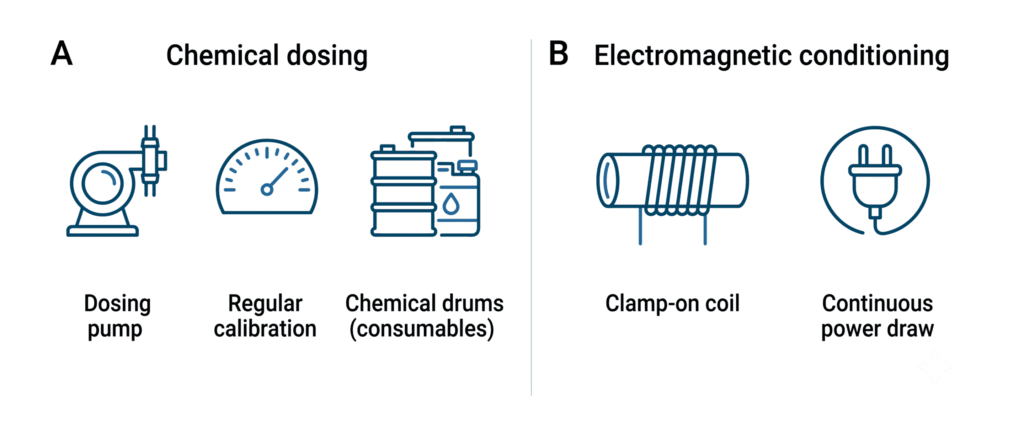
The two approaches also create very different day-to-day demands on a facilities team. A dosing program is an ongoing operational commitment: chemical deliveries need to be scheduled and stored safely, dosing pumps need calibration, and water chemistry needs periodic testing to confirm the program is still holding within its target range as make-up water quality or system load shifts.
Electromagnetic conditioning shifts most of the effort to a single point — installation. Because the technology depends on the field interacting fully with the water flowing through the pipe, coverage matters: insufficient coil wrapping around the pipe means the signal doesn’t reach all of the water passing through, which can meaningfully reduce effectiveness. Once correctly installed, however, day-to-day operational involvement is minimal by comparison — there’s no consumable to reorder, no dosing pump to calibrate, no chemical safety data sheet to keep on file.
A Word on Evidence and Track Record
This is worth addressing directly rather than glossing over: the broader category of physical, non-chemical water conditioning devices has a mixed reputation in water treatment engineering circles, in large part because the category spans a wide range of designs, frequencies, and claims, with uneven evidence behind different products. That variability is real, and it’s a fair reason for a technically-minded facilities team to be cautious of the category as a whole.
The practical implication is that “electromagnetic conditioning” shouldn’t be evaluated as a single monolithic claim. What matters is the specific engineering basis behind a specific product — documented frequency specifications, the crystallization mechanism being claimed, and real installation data — rather than the general category label. A facilities team evaluating any electromagnetic conditioning product should expect the same level of technical documentation and case-specific evidence they’d expect from a chemical dosing proposal.
Why Combining Is Usually the More Complete Approach
Because electromagnetic conditioning is specifically scoped to scale prevention, most systems get the most complete protection by pairing it with a lighter, scoped-down chemical program addressing what it doesn’t cover: corrosion inhibition and microbiological control. This isn’t a compromise or a hedge — it’s the technically sound default for the majority of water-cooled systems, since very few condenser loops are entirely free of corrosion risk or biological growth potential regardless of how well scale is managed.
The more useful question usually isn’t “chemical or non-chemical” so much as “how much chemical treatment is still needed, and for what specifically”:
- Corrosion risk — older systems, mild steel components, or infrastructure with a documented corrosion history typically still warrant a corrosion inhibitor, run at a lighter dose than a full scale-inclusive chemical program would require, since scale control is no longer part of its job
- Microbiological control — biocide dosing generally remains necessary alongside electromagnetic conditioning, which has no direct mechanism for controlling bacterial or algae growth on its own
- Discharge and effluent constraints — even a scoped-down chemical program still discharges some treatment chemicals in blowdown; facilities with strict effluent limits should weigh this when deciding what residual dosing to retain
- Installation and operational preference — systems that can’t tolerate any ongoing chemical handling may need to solve corrosion and biological control through other means, accepting a narrower protection scope as a deliberate, informed trade-off rather than an oversight
For most water-cooled systems, the more defensible starting assumption is combination: electromagnetic conditioning handling scale, and a scoped-down chemical program.
For facilities specifically interested in exploring the electromagnetic conditioning path, HannveTech’s SWATS solution is built on electromagnetic pulse-wave technology, engineered specifically around the scale-prevention mechanism discussed throughout this piece. It’s designed to function as the scale-control layer of a broader water treatment program — worth evaluating alongside, not instead of, whatever your system needs for corrosion and biological control.


