
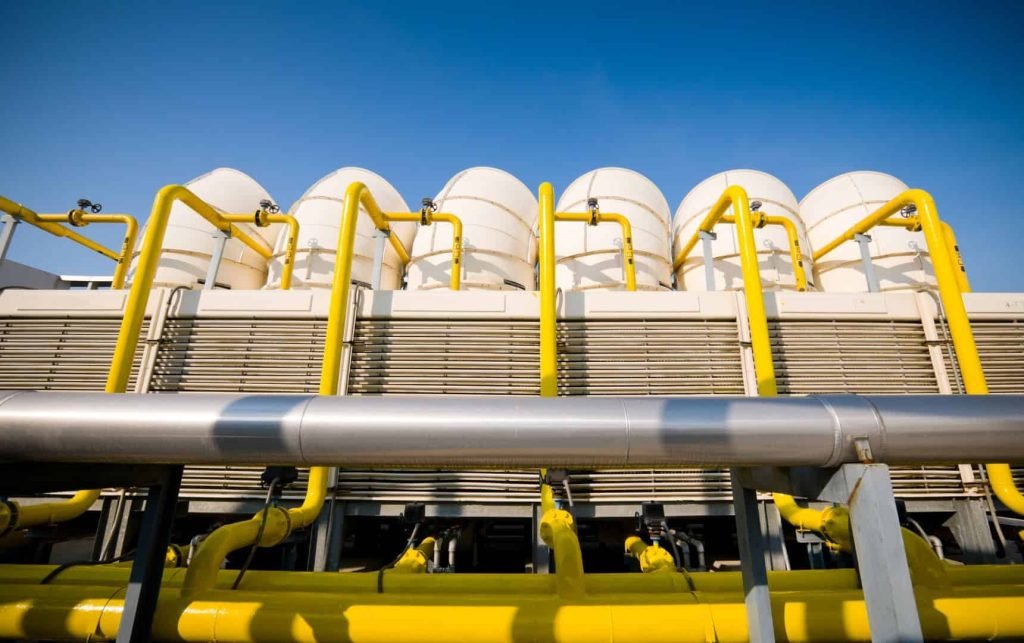
This is one of the most common and least understood patterns in facilities management where a system that isn’t broken, but also isn’t doing its job as efficiently as it used to.
It’s tempting to file this under “ageing equipment” and move on. But equipment age alone doesn’t explain why a chiller that passed commissioning with strong performance numbers now needs measurably more energy to deliver the same cooling load. The real explanation is usually happening somewhere no maintenance checklist looks: inside the condenser tubes, one microscopic layer at a time.
An Efficiency Loss That Never Trips an Alarm
Chillers are built to report operational status — load, pressures, temperatures, fault codes. What they are not built to report is the slow, physical narrowing of their own heat transfer surface. There is no alarm for “condenser tubes are 2% less efficient than they were last year,” because nothing has technically failed. The compressor still runs. The refrigerant cycle still completes. Every component is still doing exactly what it was designed to do.
It’s simply doing it against a growing obstacle that wasn’t there on commissioning day. That obstacle has a name, and it’s one of the most overlooked cost drivers in cooling: scale.
What’s Actually Happening Inside the Tube?
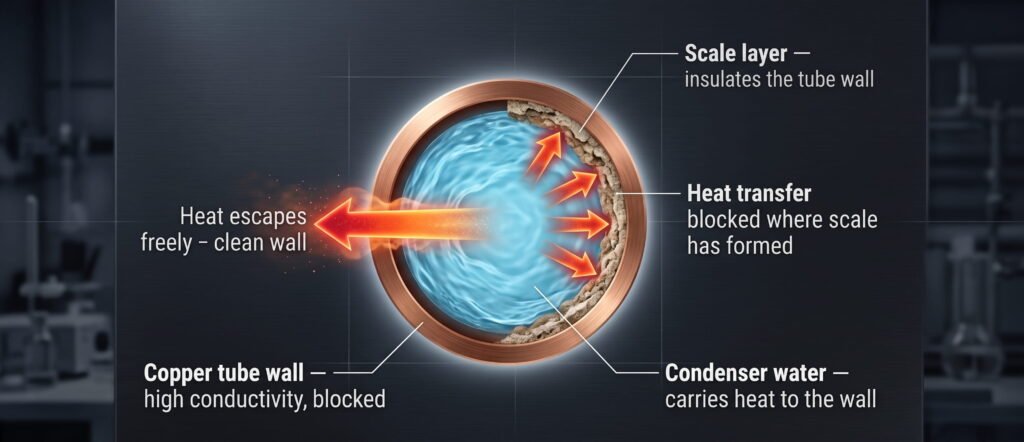
Water-cooled chiller systems rely on two components working in tandem. The chiller itself behaves like a refrigerator, extracting heat from the building through the refrigerant cycle. The cooling tower behaves like a giant radiator, rejecting that heat into the atmosphere through water evaporation. Efficiency depends on how easily heat can move from the condenser water, across the tube wall, and out into the air.
Scale gets in the way of that handoff. In HVAC systems, scale refers to hard, rock-like mineral deposits predominantly calcium carbonate that form on the inside of condenser tubes and heat exchangers. It’s the same basic chemistry as the crust that builds up inside a kettle: hard water carries dissolved minerals, and as that water is repeatedly heated and evaporated in the cooling tower, those minerals become unstable and begin settling out of solution onto the nearest available surface, usually the condenser tube wall. It happens gradually and it happens continuously, which is exactly why it stays invisible for so long.
Why a Layer You Can Barely See Costs So Much?
The reason a thin mineral layer has an outsized effect comes down to basic physics: how well different materials conduct heat.
The Carrier Handbook of Air Conditioning System Design quantifies the gap clearly. Measured in thermal conductivity (W/m·K — a measure of how readily a material transfers heat):
Material | Thermal Conductivity (W/m·K) | Relative to Copper |
| Copper (tube wall) | 401 | Baseline |
| Carbon steel | 50 | ~12% of copper |
| Calcium carbonate scale | 2.9 | ~0.7% of copper |
| Biofilm | 0.6 | ~0.15% of copper |
Source: Carrier Handbook of Air Conditioning System Design, Part 5 — Water Conditioning
Condenser tubes are made of copper specifically because it conducts heat so well. Scale is, by comparison, an almost perfect insulator sitting exactly where heat transfer needs to happen fastest. Even a layer far too thin to see with the naked eye is enough to meaningfully choke the rate at which heat can cross the tube wall.
When that happens, the chiller is left with two options: provide less cooling, or work harder. In most cases, it chooses the second. It runs for longer periods, draws more power, and consumes more electricity just to remove the same amount of heat through a surface that is no longer transferring heat as effectively as it once did. The building still gets cooled while it costing more energy to achieve the same result
Why It Compounds for Years Before Anyone Notices?
Scale formation doesn’t announce itself with a single dramatic event, it builds in layers continuously, for as long as untreated water keeps cycling through the system. That’s what makes it so different from a typical maintenance issue: there’s no discrete moment where a technician would flag it during a routine inspection, because nothing is out of tolerance on any single day. It simply looks slightly worse than the month before.
This is particularly true for systems that have been in continuous service for years without full retro-commissioning including commercial buildings, factories, hospitals, and hotels alike, where chiller plants often run for a decade or more between major overhauls. Efficiency erodes in the background the entire time, showing up only indirectly: in electricity bills that creep upward independent of weather or occupancy, or in a system that seems to need more runtime hours to hold the same setpoint it used to hold comfortably.
Signs Worth Watching For 🔎
Without lab testing, most facilities teams won’t be able to quantify scale thickness directly, but a few operational trends are worth tracking over time as early indicators:
- Cooling energy consumption (kWh per RT) trending upward year-over-year under comparable load and weather conditions
- Condenser approach temperature widening gradually rather than staying flat
- More frequent manual adjustment needed to maintain the same chilled water setpoint
- A chiller plant that has gone several years without a condenser tube inspection or full retro-commissioning
None of these alone is conclusive, but a pattern across several of them is a reasonable signal that it’s worth investigating what’s happening inside the condenser loop specifically a topic covered in more depth in a companion checklist for facilities teams.
The Good News: It’s a Physical Process, Not an Inevitability
The reason this matters is also the reason it’s fixable. Scale formation is a well-understood physical and chemical process where supersaturated mineral solution meeting the right conditions to precipitate onto a surface. It isn’t random, and it isn’t an unavoidable cost of running a chiller plant for years. Facilities teams typically address it in one of two ways: periodically removing scale after it forms, or preventing the mineral deposition process from occurring in the first place including through non-chemical approaches such as electromagnetic conditioning, which intervene in the water chemistry before scale has a chance to adhere to the tube wall.
The mechanics of how that prevention actually works and why it doesn’t just relocate the problem elsewhere in the loop — is worth its own explanation, which we cover in a separate piece on the science of electromagnetic scale prevention.
For now, the key takeaway is simpler: if your chiller’s energy consumption has been climbing without a corresponding fault, breakdown, or change in load, the absence of an alarm doesn’t mean the absence of a problem. It may just mean the problem is exactly where no alarm is designed to look.


