

What Cycle of Concentration Actually Measures
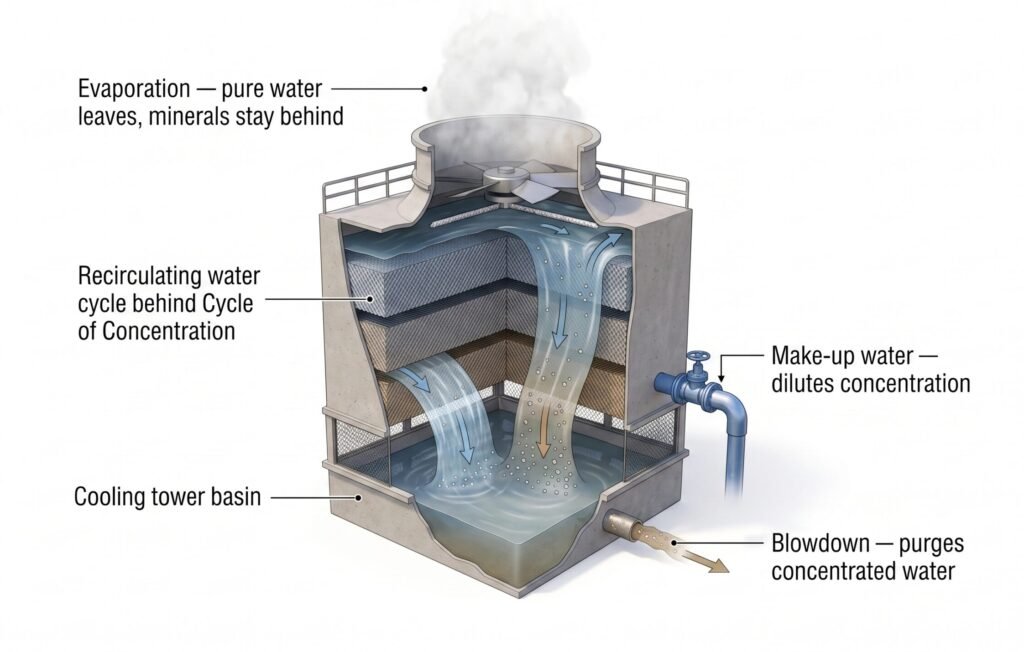
A cooling tower’s job is to reject heat by evaporating water. Every time pure water evaporates off the top of the tower, the dissolved minerals it was carrying stay behind in the water that remains. Left unchecked, that concentration would climb indefinitely — so cooling towers deliberately discharge a portion of the concentrated water on purpose. That discharge is called blowdown (or bleed), and it’s replaced by fresh make-up water, which dilutes the mineral concentration back down before the cycle repeats.
Cycle of Concentration (CoC) is simply a count of how many times the same water has been concentrated by evaporation before it’s purged as blowdown. A CoC of 1 would mean water is replaced almost as fast as it evaporates — maximum water usage, minimum mineral buildup. A CoC of 6 means the water has been allowed to concentrate to roughly six times the mineral level of the incoming make-up water before being discharged — meaning significantly less make-up water is needed to run the system over the same period.
How to Calculate It
Two practical methods are used in the field, and it’s worth knowing both:
Conductivity ratio — the fastest and most common method. Dissolved minerals conduct electricity, so as water concentrates, its electrical conductivity rises roughly in proportion. Most systems already have a conductivity controller monitoring this and automatically triggering the bleed valve once a setpoint is reached.
| CoC = Conductivity of circulating (condenser) water ÷ Conductivity of make-up water |
Water balance — a useful cross-check using water meter data over any given period, since (ignoring minor drift losses) roughly all the make-up water added either evaporates or leaves as blowdown:
| CoC ≈ Volume of make-up water ÷ Volume of blowdown |
If the two methods disagree significantly, it’s usually worth checking meter calibration or confirming the conductivity controller’s setpoint actually matches what’s been assumed — a mismatch here is more common than most facilities teams expect.
Why Pushing CoC Higher Matters
The relationship between CoC and water consumption isn’t linear — each additional cycle of concentration reduces make-up water demand, but with diminishing returns as CoC climbs higher. Even so, the potential savings are real and often underexploited.
According to PUB’s Technical Reference for Water Conservation in Cooling Towers (2017), Singapore’s potable water supply can typically sustain a CoC of 6–8 without acid injection (a supplementary dosing technique that controls pH to allow the water to concentrate further before scaling risk rises), or 10–15 with acid injection. NEWater, which carries a lower mineral content to begin with, can sustain a higher CoC of 8–17 without acid injection, and 15–20 with it.
In practice, many facilities operate well below these ceilings — deliberately running a lower CoC than their water source could support, specifically to stay clear of scaling risk. That’s a reasonable instinct on its own terms, but it also means real, quantifiable water savings are often sitting untapped, unused not because the water supply couldn’t support a higher CoC, but because the system’s scale management approach couldn’t keep up with the mineral concentration that a higher CoC would bring.
For water-cooled data centres specifically, this same lever feeds directly into Water Usage Effectiveness (WUE) — a facility-level water efficiency metric where a higher sustained CoC is one of the most direct ways to move the number in the right direction.
Why CoC Has a Ceiling: The Scale Trade-off
This is where Cycle of Concentration connects directly back to everything scale-related: pushing CoC higher means concentrating dissolved minerals further, which pushes the water closer to supersaturation — the same unstable, “overfull” state that precedes scale formation. That’s precisely why CoC has a practical ceiling in the first place, and why that ceiling isn’t fixed — it’s a function of how well a system’s scale management approach can handle a more concentrated water chemistry.
This is also why the choice of scale management approach — whether chemical dosing, electromagnetic conditioning, or some combination of the two — has a direct, measurable relationship with how high CoC can safely run. The better a system controls scale formation at a given mineral concentration, the more headroom exists to push CoC toward the ceiling the water source can sustain, rather than stopping short of it out of caution.
What’s Actually Limiting Your CoC?
It’s worth asking a genuinely practical question here: is your system’s current CoC setpoint based on a measured, current assessment of your scale management approach — or is it a conservative default that’s been left untouched since commissioning, possibly years before the system’s water treatment approach last changed?
Controller setpoints are often set once, cautiously, and rarely revisited unless something goes wrong. That caution made sense at the time it was set. Whether it still reflects the system’s actual scaling risk today is a separate question — and one worth periodically re-examining rather than assuming.
Why This Number Deserves Your Attention
Cycle of Concentration sits at the intersection of three things every facilities team is already accountable for: water cost, energy efficiency, and equipment longevity. Few other single metrics connect that directly to day-to-day operating cost. Whatever scale management approach a system uses, understanding what’s actually setting the ceiling on CoC — and whether that ceiling reflects current reality — is one of the more concrete, actionable exercises a facilities team can run.


