
What Makes Water “Hard” in the First Place
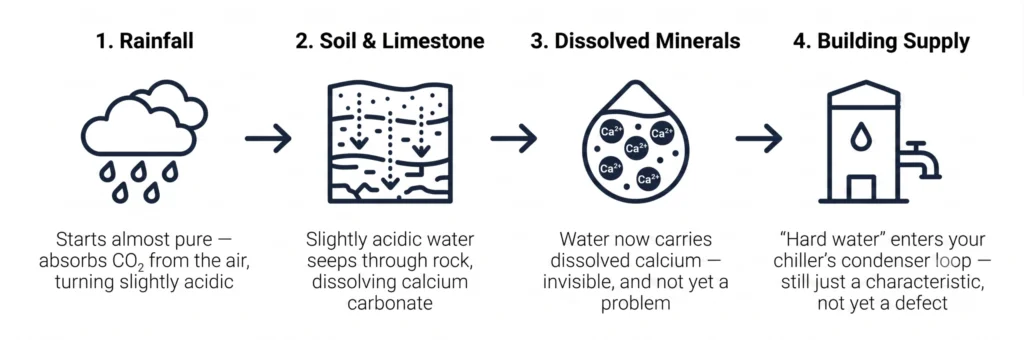
Rainwater starts out close to pure. As it falls through the atmosphere, it absorbs a small amount of carbon dioxide, making it slightly acidic. That mildly acidic water then seeps through soil and rock, where it dissolves minerals it comes into contact with — calcium carbonate among them, drawn from limestone and similar deposits underground.
By the time that water reaches a local supply, it’s carrying dissolved calcium. That’s all “hard water” means: water that picked up dissolved minerals on its way into the system. On its own, it isn’t a defect — it’s simply a characteristic of where the water came from, and it’s true of most water supplies to varying degrees.
The problem isn’t the hardness itself. It’s what happens when that water is then cycled repeatedly through heat.
Why Cooling Towers Turn a Mild Characteristic Into a Concentrated Problem
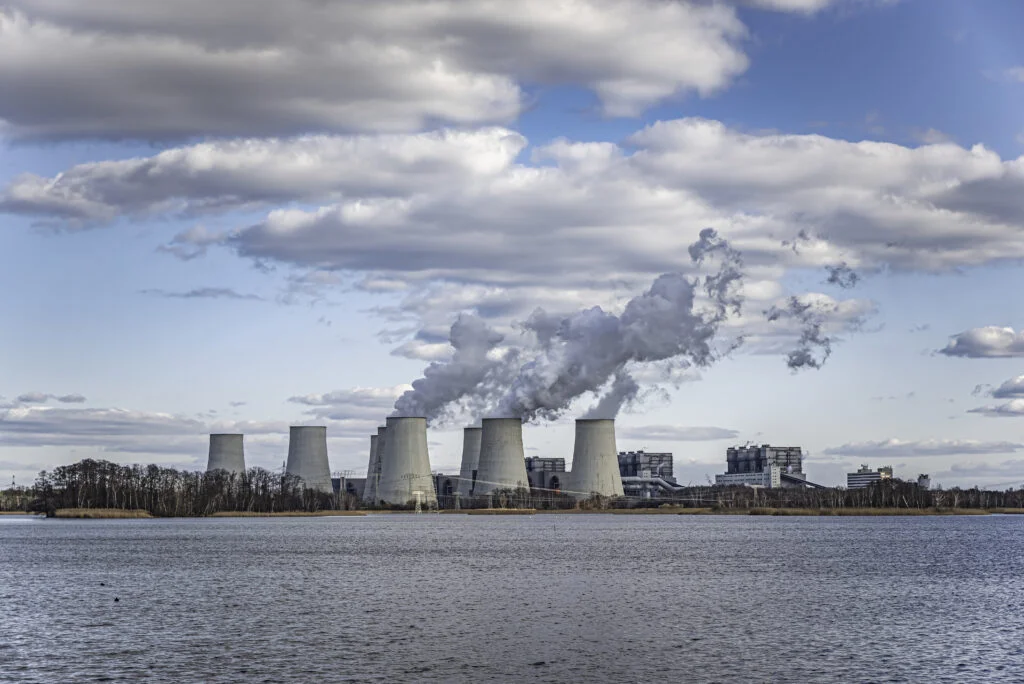
A cooling tower’s entire job is to reject heat by evaporating water. Every time pure water evaporates off the top of the tower, the dissolved minerals it was carrying stay behind in the water that remains. Cycle after cycle, the same batch of water keeps losing pure H₂O to evaporation while its mineral load stays put — so the concentration of dissolved calcium keeps climbing. This ratio of concentrated minerals to fresh make-up water is what facilities engineers track as Cycle of Concentration (CoC): the higher the CoC, the more concentrated — and more scale-prone — the water in the loop has become.
There’s a second mechanism working in parallel. As water splashes and aerates across the cooling tower’s infill material, dissolved carbon dioxide is stripped out of it and released into the atmosphere. Losing that CO₂ reduces the water’s carbonic acid content, which causes its pH to rise slightly. That rise in pH directly lowers how much calcium carbonate the water can hold in solution — pushing an already-concentrated solution even closer to the point where it can’t stay dissolved anymore.
The Moment Dissolved Becomes Deposited
Water can actually hold more dissolved calcium carbonate than its theoretical solubility limit for a surprisingly long time — a state chemists call supersaturation. Forming an actual solid crystal from a dissolved mineral requires overcoming an energy barrier, and until something triggers that first crystal formation, the mineral stays suspended, invisible, doing no damage.
That trigger is called nucleation: the moment microscopic mineral clusters first form and act as seeds for further crystal growth. Rising temperature, rising pH, and slower flow velocity — all of which are naturally present inside a condenser loop — make nucleation easier to trigger. Once it happens, growth from that first seed can continue quickly.
Why It Sticks: The Difference Between Floating and Bonding
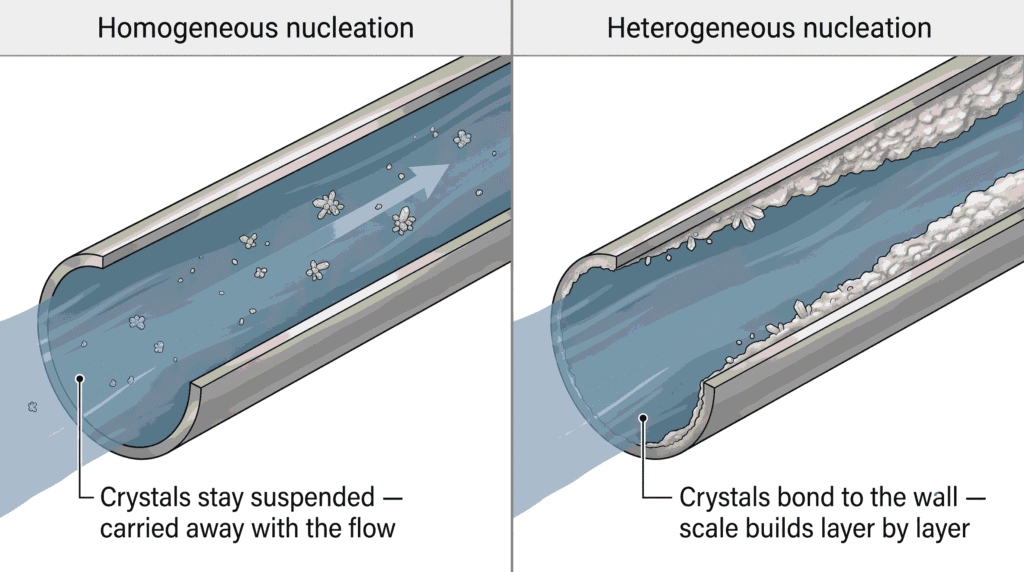
This is the part that actually determines whether calcium carbonate becomes your problem or just passes through harmlessly: where nucleation happens.
If those first mineral crystals form out in the open water — a process called homogeneous nucleation — they stay suspended as free-floating particles that can simply be carried along with the flow.
If they form directly on a surface instead — heterogeneous nucleation — the story is very different. The metal tube wall itself becomes the seed for crystal growth, and the crystals that form this way are calcite: a rhombohedral crystal structure that happens to be the most thermodynamically stable form calcium carbonate can take under these surface conditions. Stable, in this context, means firmly bonded — calcite doesn’t just rest against the tube wall, it grows into a hard, adherent layer that keeps building with every cycle the water makes through the system.
In an untreated system, heterogeneous nucleation on the tube wall is the default pathway. That’s the literal answer to what calcium carbonate does inside a condenser tube: left alone, it doesn’t stay in the water — it plates itself onto the metal, one microscopic layer at a time.
Two Costs Once It’s There
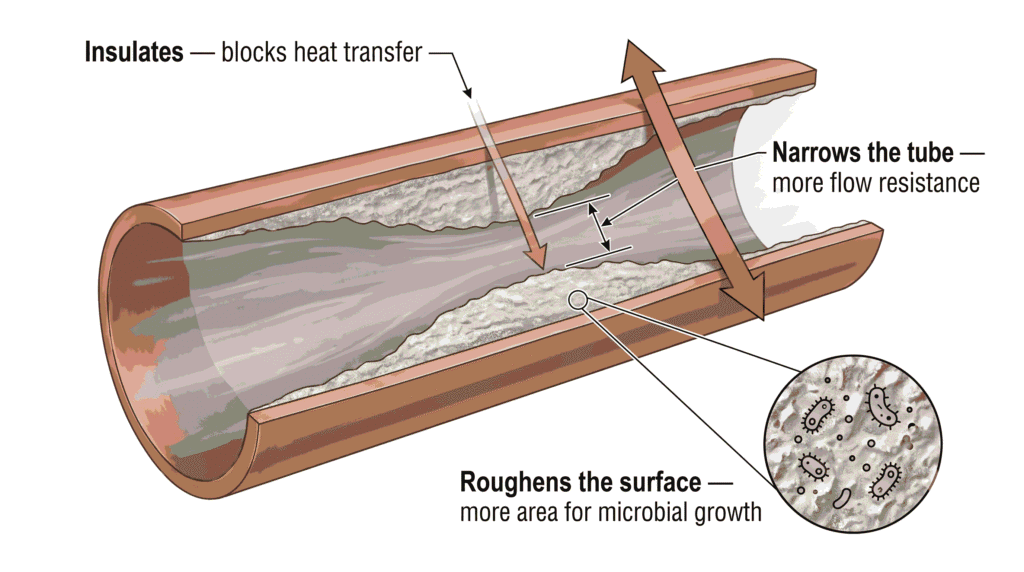
Once calcite has bonded to the tube wall, it creates problems in more than one direction:
- It insulates. Calcium carbonate scale conducts heat far less effectively than the copper it’s sitting on — a gap significant enough to meaningfully choke heat transfer even at a thickness too thin to see. (This mechanism is covered in more depth in a companion piece on invisible efficiency loss.)
- It narrows the pipe. As layers accumulate, the internal diameter of the tube shrinks. A narrower channel means more resistance to flow, which typically means pumps have to work harder to move the same volume of water — an energy cost stacked on top of the heat-transfer penalty.
- It roughens the surface. A scaled surface is a textured one, and texture gives microbial colonies — including organisms like Legionella that facilities teams already monitor for in cooling towers — considerably more surface area to establish themselves than a smooth, clean tube wall would.
None of these three effects requires a system failure to be true. They accumulate quietly, in parallel, for as long as untreated water keeps completing the cycle.
Not All Calcium Carbonate Behaves the Same Way
It’s worth being precise here: calcite isn’t the only form calcium carbonate can take. Aragonite — a different, orthorhombic crystal structure of the same mineral — carries a reported solubility constant of roughly 4.57 × 10⁻⁹, noticeably higher than calcite’s roughly 3.3 × 10⁻⁹. There’s also an amorphous, non-crystalline form (ACC) that’s roughly 100 times more soluble than either crystal structure.
In practical terms: not every version of “calcium carbonate in your water” behaves like scale. Which form actually ends up forming — and where — determines whether it locks onto your tubes or simply gets carried away with the flow. That distinction is significant enough to deserve its own explanation, which we cover in a dedicated piece comparing calcite and aragonite directly.
Why This Matters Before You Look at Any Solution
None of this is a mystery process. Hard water chemistry, supersaturation, and nucleation are well-documented, well-understood physical mechanisms — not something specific to any one building, chiller brand, or climate. That’s actually good news: a process this well understood is also a process that can be deliberately interrupted, whether through periodic mechanical cleaning or through technologies designed to influence which type of nucleation happens in the first place.
Understanding this sequence — hardness, concentration, supersaturation, nucleation, adhesion — is the foundation for evaluating any scale-management approach on its actual merits, rather than on marketing claims alone.
In practical terms: not every version of “calcium carbonate in your water” behaves like scale. Which form actually ends up forming — and where — determines whether it locks onto your tubes or simply gets carried away with the flow. That distinction is significant enough to deserve its own explanation, which we cover in a dedicated piece comparing calcite and aragonite directly.


