
What GSTC Actually Is
The Global Sustainable Tourism Council sets the most widely recognized standard for sustainable tourism globally, developed with a coalition that included the UN Environment Programme, UN Tourism (UNWTO), the International Union for Conservation of Nature, and major hospitality brands including Marriott and Fairmont. The GSTC Hotel Standard (formerly the GSTC Hotel Criteria) is organized around four pillars:
Hotels pursue GSTC alignment for reasons that go beyond internal sustainability goals. It’s increasingly a market-access question: corporate travel programs, online travel agencies, and tour operators are filtering supplier selection by credible sustainability certification, and major hotel brands increasingly reference or require GSTC-aligned practices at the property level. A credential built on independent, internationally recognized criteria carries more weight with these audiences than a hotel’s own sustainability claims.
Why Hospitality’s Footprint Is Disproportionate
This isn’t a marginal concern for the sector. According to GSTC’s own published rationale for its standard, the hospitality industry accounts for roughly 1% of total global carbon emissions, and hotel operations have been found to consume up to eight times more water than the communities that surround them. That disproportionate footprint — high resource intensity relative to the sector’s economic scale — is precisely why GSTC’s Environmental pillar weighs energy and water conservation as heavily as it does. It isn’t an arbitrary checklist item; it reflects where the sector’s actual impact concentrates.
Where Cooling Sits Within the Environmental Pillar
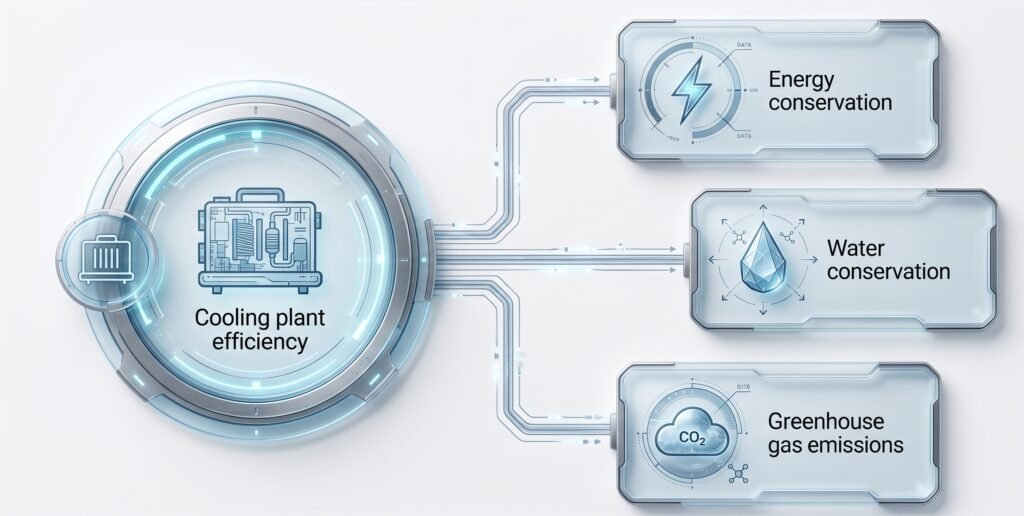
GSTC’s certification requirements explicitly identify energy conservation, water conservation, greenhouse gas emissions, and pollution reduction as core assessed areas within the Environmental pillar, alongside solid waste management and responsible purchasing. For any hotel running a water-cooled chiller plant — the norm for mid-to-large properties across Singapore — cooling is very likely the single largest energy and water draw in the building, running near-continuously regardless of occupancy.
That concentration means cooling plant efficiency isn’t a narrow technical fix sitting outside a hotel’s sustainability story. It sits directly inside at least three separate areas of GSTC’s environmental assessment simultaneously: energy conservation, water conservation, and the greenhouse gas emissions that follow from both.
Beyond Energy and Water: Chemical Discharge and Pollution Reduction
GSTC’s environmental assessment doesn’t stop at energy, water, and emissions — it also extends to how a property manages the pollutants it discharges, and cooling tower water treatment is a direct source of exactly that kind of discharge. Traditional treatment programs rely on biocides, corrosion inhibitors, and dispersants that are, by design, released into the environment through blowdown as routine operational practice. That practice carries real, well-documented environmental costs: biocides are toxic to aquatic life by design, phosphate-based formulations contribute to eutrophication and harmful algal blooms downstream, and some corrosion inhibitors rely on zinc-based compounds that bioaccumulate in ecosystems over time.
This isn’t a hypothetical concern for a GSTC assessment. Chemical usage disclosure is an increasingly explicit expectation across major sustainability reporting frameworks, and blowdown discharge from a cooling tower sits squarely inside it — a hotel’s water treatment program is something an assessor can reasonably expect a property to account for, not an operational detail that sits outside the scope of review.
Non-chemical treatment approaches change that picture directly rather than incrementally. Copper-Silver Ionization (CSI), the biological control component of platforms like HannveTech’s SWATS+, introduces only trace levels of naturally occurring metallic ions — typically under 1 part per million (ppm) combined — in place of a program built on biocides and phosphate-laden formulations, removing eutrophication risk and the bioaccumulation concerns tied to zinc and synthetic organic compounds. For a hotel’s discharge monitoring obligations, the practical effect is real simplification: fewer chemicals to track, fewer compounds subject to discharge permit scrutiny, and a cleaner answer when an assessor asks what’s actually leaving the property through the cooling tower.
Practical Implications for GSTC-Aligned Hotels
For a hotel pursuing or maintaining GSTC alignment, this points to a specific opportunity: cooling plant efficiency is one of the few interventions capable of moving multiple environmental indicators simultaneously, rather than requiring a portfolio of narrower initiatives each targeting a single metric. The underlying mechanism — scale buildup inflating both energy and water consumption in a water-cooled chiller system — is universal across building types, not specific to hotels, but hospitality’s continuous, guest-driven cooling demand makes the effect particularly concentrated and particularly visible in a property’s utility data.
For hotels evaluating this path, HannveTech’s SWATS+ platform — combining electromagnetic scale prevention with CSI for biological control and water quality monitoring — is engineered around exactly this integrated view: addressing energy, water, and chemical discharge together, rather than treating them as separate problems requiring separate initiatives.
Sources 🌐
- Global Sustainable Tourism Council (GSTC), GSTC Hotel Standard — source for the four-pillar structure and the core environmental assessment areas (energy conservation, water conservation, GHG emissions, pollution reduction): org
- GSTC, Revision of the GSTC Industry Criteria for Hotels and Tour Operators (Terms of Reference) — source for the “1% of global carbon emissions” and “eight times more water than neighbouring communities” figures, stated verbatim in GSTC’s own document: org
- CSI mechanism, ppm concentration figures, and chemical treatment discharge comparison courtesy of HannveTech’s own technical documentation on the SWATS+ platform


