

The Basic Conversion
The underlying formula is simple, using the grid emission factor expressed in kilograms of CO2 equivalent per kilowatt-hour (kgCO2e/kWh):
| tCO2e = (kWh saved × grid emission factor in kgCO2e/kWh) ÷ 1,000 |
Consider a facility that reduces its annual chiller electricity consumption by 500,000 kWh — a purely illustrative figure, not tied to any specific installation. Applied to Singapore’s current grid emission factor of 0.402 kgCO2/kWh, that’s roughly 201 tCO2e avoided per year. Applied to Peninsular Malaysia’s current grid emission factor of approximately 0.740 kgCO2e/kWh, the identical energy saving works out to roughly 370 tCO2e — nearly double.
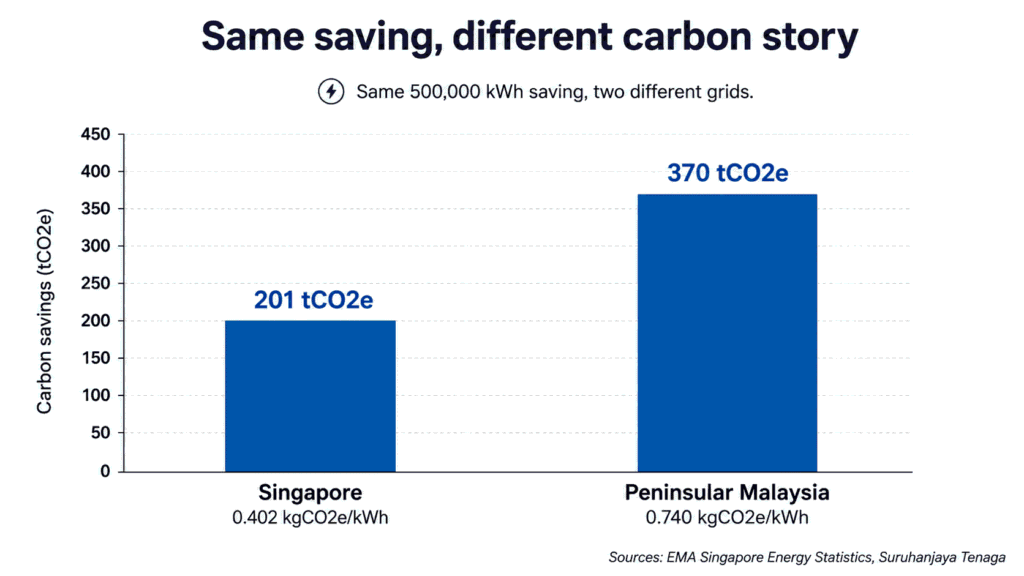
That gap isn’t a rounding error. It’s the direct result of two different national grids running on different fuel mixes, and it’s exactly why the emission factor you select isn’t a minor technical footnote — it’s the single input that most determines the size of the number your organization ends up reporting.
Which Emission Factor Actually Applies to Your Facility
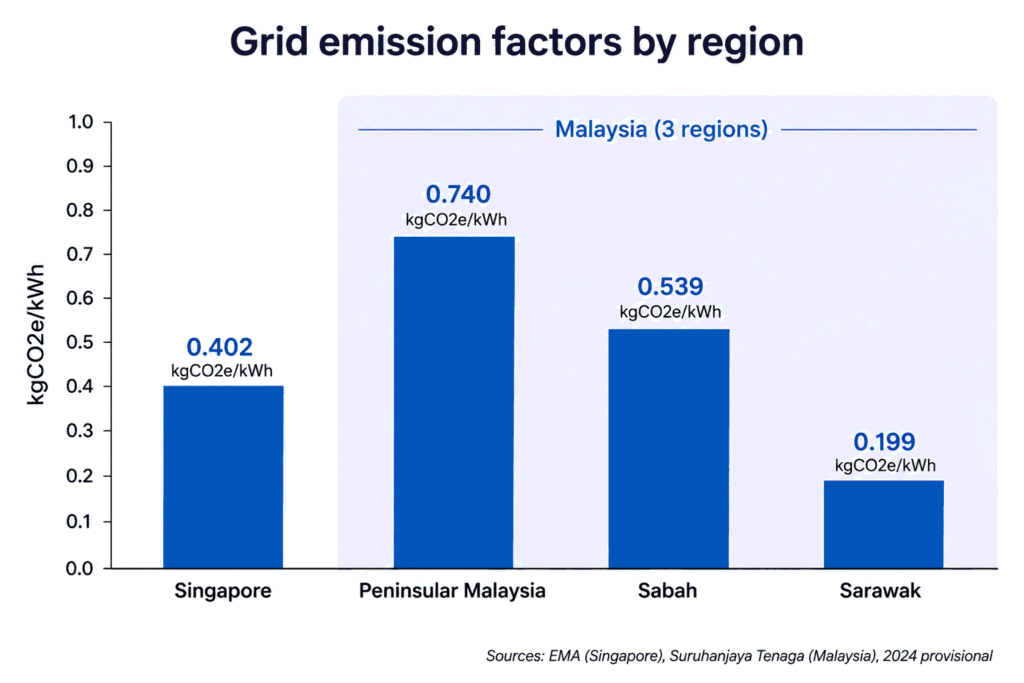
Singapore publishes its Grid Emission Factor (GEF) annually through the Energy Market Authority (EMA), in the Singapore Energy Statistics publication. The most recent figure is 0.402 kgCO2/kWh for 2024, down from 0.412 in 2023 — largely reflecting a higher share of solar in the fuel mix and improved emissions intensity from generators. Because this figure changes year to year, the emission factor used in a sustainability report should always match the actual reporting period, not a cached figure from a previous year’s calculation.
Malaysia publishes separate grid emission factors by region through Suruhanjaya Tenaga (the Energy Commission), reflecting genuinely different generation mixes across the country. The most recent provisional 2024 figures are approximately 0.740 kgCO2e/kWh for Peninsular Malaysia, 0.539 for Sabah, and 0.199 for Sarawak — the last of these dramatically lower due to Sarawak’s hydropower-dominated grid. A facility in Sarawak and a facility in Johor are not on the same grid and should never use the same factor, even though both fall under “Malaysia” in a corporate reporting spreadsheet.
The general principle holds regardless of country: grid factors are specific to a location and a year. Reusing an old figure, or borrowing a neighbouring country’s or region’s number because it’s numerically close, produces a technically incorrect Scope 2 disclosure — even when nobody notices at first.
Location-Based vs. Market-Based: Which Number Are You Actually Reporting?
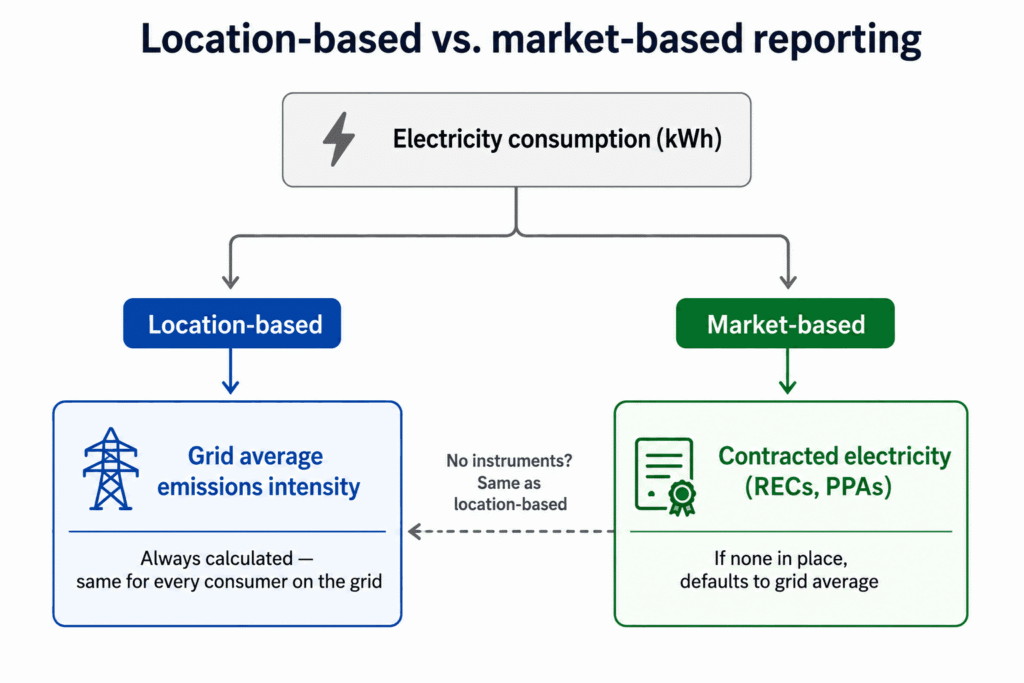
The Greenhouse Gas (GHG) Protocol’s Scope 2 Guidance requires most reporting companies to disclose emissions using two distinct methods, known as dual reporting:
- Location-based — emissions calculated using the average emissions intensity of the local grid, which is what the calculation above uses. This method treats every consumer on the same grid identically, regardless of what any individual company has purchased.
- Market-based — emissions calculated based on the electricity a company has specifically contracted for, through instruments like Renewable Energy Certificates (RECs) or Power Purchase Agreements (PPAs). If no such instruments are in place, the market-based figure typically defaults to the same grid-average data used in the location-based calculation.
Chiller efficiency improvements affect the location-based figure directly, since they reduce actual metered kWh consumption regardless of what energy contracts are in place. If a facility also holds renewable energy certificates or a green electricity tariff, both the location-based and market-based figures should be disclosed separately — collapsing them into a single number is one of the more common errors that draws questions during external assurance.
Reduced Emissions, Not “Avoided Emissions” — Getting the Label Right
This distinction is smaller in wording than in consequence. A facility’s own chiller efficiency improvement, measured against its own historical consumption baseline, is a genuine Scope 2 emission reduction within that facility’s own greenhouse gas inventory. It should be reported as a reduction against baseline, in the same inventory boundary as the rest of the organization’s Scope 2 figures.
“Avoided emissions” is different, more specific terminology under GHG Protocol guidance — reserved for emissions that a third party avoids by using a company’s product or service, reported separately and outside that company’s own Scope 1/2/3 inventory, not netted against it. The GHG Protocol itself warns that these claims frequently don’t hold up to scrutiny, precisely because companies misapply the term to internal operational improvements that don’t actually meet the definition.
For a facility reducing its own chiller energy consumption, the correct framing is straightforward: a real, measured reduction inside your own Scope 2 inventory. Auditors and assurance providers reviewing a sustainability report will specifically check that reduction claims are scoped and labeled correctly — this is one of the easiest things to get right, and one of the more common places it goes wrong.
What Makes the Number Audit-Defensible
A handful of practices separate a number that survives assurance from one that draws follow-up questions:
- A clearly defined baseline. A single before-and-after snapshot isn’t sufficient — ideally, savings are normalized against comparable load and weather conditions, not just measured against whatever the prior period happened to look like.
- Metered, not estimated, data. Actual kWh consumption data carries more weight than modeled or estimated savings figures.
- Traceable factor sourcing. Cite the specific publication and year the emission factor came from — “government figures” isn’t a citation; “EMA Singapore Energy Statistics, 2024” is.
- Documented assumptions. Any adjustment, normalization, or estimation method used should be stated plainly rather than embedded silently in the final number.
Why This Translation Work Matters
Engineering teams are fluent in kWh. Boards and disclosure frameworks are fluent in tCO2e. The organizations that report this well aren’t the ones with the largest savings — they’re the ones whose numbers hold up when someone asks how they were calculated. Chiller efficiency improvements, including those delivered through non-chemical scale prevention technologies such as SWATS, produce real, metered energy reductions that translate cleanly into this kind of reporting — provided the translation itself is done with the same rigor as the engineering work behind it.
Sources 🌐
- Energy Market Authority (EMA), Singapore Energy Statistics, Chapter 2: Energy Transformation — source for Singapore’s Grid Emission Factor, 0.412 kgCO2/kWh (2023) to 0.402 kgCO2/kWh (2024): gov.sg
- Suruhanjaya Tenaga (Energy Commission Malaysia), Grid Emission Factor (GEF) in Malaysia, 2022–2024 (Provisional) — source for the Peninsular Malaysia, Sabah, and Sarawak grid emission factors: st.gov.my
- GHG Protocol, Scope 2 Guidance (2015) — source for the location-based/market-based dual reporting requirement and the avoided-emissions distinction. Note: a revision to this guidance was under public consultation as of late 2025; figures here reflect the currently standing 2015 guidance: org


