

The Facility and the Challenge
The client operates a lithium battery manufacturing plant in Tuas, Singapore, as part of a multinational group. The facility’s water-cooled chiller system was 20 years old at the time of this project — among the oldest systems covered in this case study series, and a genuine test of whether scale-driven efficiency loss can be recovered on legacy infrastructure, not just newer equipment. As with other cases in this series, the business case rested on two drivers: alignment with the group’s net-zero and decarbonization targets, and compliance support for Singapore’s Minimum Energy Efficiency Standards (MEES) for water-cooled chilled water systems.
What Was Installed
SWATS EMF Technology were installed on the plant’s two 26″ condenser sub-header pipes. As with every installation in this series, the approach was non-invasive — no cutting or welding into existing pipework, and no moving parts in the units themselves, meaning no scheduled downtime was required to install the system.
A Guarantee, Not Just a Projection
This project was structured the same way as other cases in this series: around a formal Measurement and Verification (M&V) process with a contractually guaranteed Key Performance Indicator, not a projected estimate. The guarantee here was a minimum 6% improvement in overall chiller efficiency within six months of implementation, measured against a documented pre-installation baseline established from 13 September to 21 October 2025.
Performance was then tracked using data sourced from the client’s own Building Management System (BMS) across a monitoring period running through 16 June 2026 — roughly nine months of continuous observation in total.
The Results
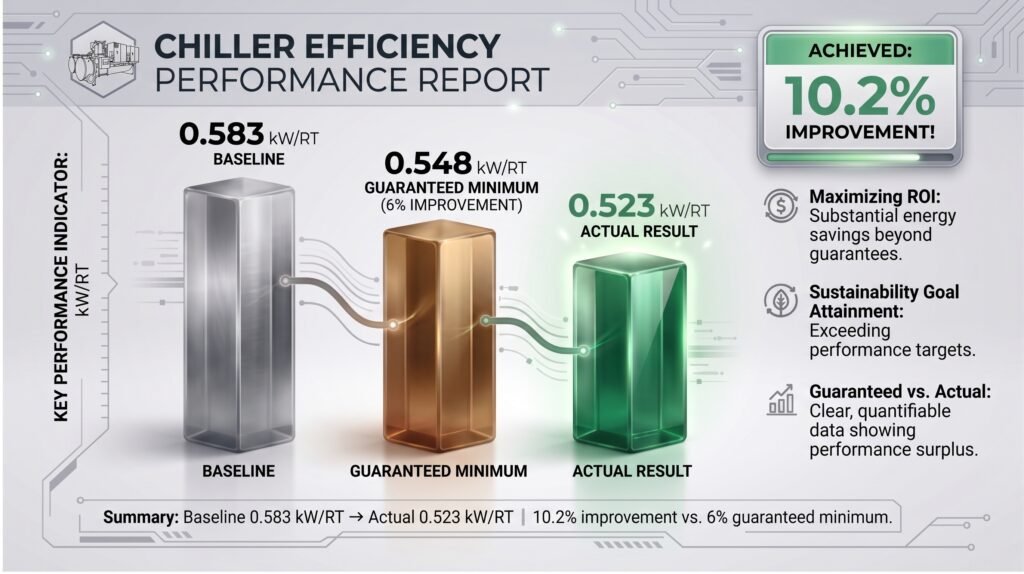
The system delivered a 10.2% improvement in Total Chillers Efficiency, from a baseline of 0.583 kW/RT to 0.523 kW/RT — comfortably ahead of the guaranteed 6% minimum.* Alongside the efficiency gain, the project delivered a return on investment within under two years, driven by the combination of energy savings and reduced maintenance costs from no longer needing to replace scale-damaged cooling tower infills as frequently.
What This Means for Similar Facilities
The age of this system is the detail worth sitting with. A 20-year-old chiller plant isn’t usually where a facilities team expects to find double-digit efficiency gains — ageing systems tend to get managed conservatively, on the assumption that major improvement requires major capital replacement. This case suggests that assumption deserves a second look specifically where the underlying cause is scale accumulation: the mechanism doesn’t become harder to reverse because the equipment is old, and a well-documented, professionally installed intervention was able to recover a meaningful share of the system’s original design efficiency regardless of its age.
For manufacturing facilities weighing similar decisions — particularly those with legacy chiller plants and active net-zero or MEES compliance obligations — this case reflects the kind of documented, guaranteed, and independently verified result those commitments are built to recognize.
* Results vary according to actual scaling conditions and system parameters. Case study data drawn from HannveTech’s own performance report covering the period 13 September 2025 to 16 June 2026, prepared under a formal Measurement and Verification process. Client identity withheld in accordance with a non-disclosure agreement.


