
The Utility Cost Half
Cooling towers aren’t the largest single water draw in a hotel — guest rooms and laundry typically claim bigger shares — but at roughly 12–15% of total hotel water use, they’re a meaningful, addressable slice, and one that’s easy to overlook precisely because it happens entirely in the back of house, invisible to guests and often under-monitored by engineering teams stretched across dozens of other priorities.
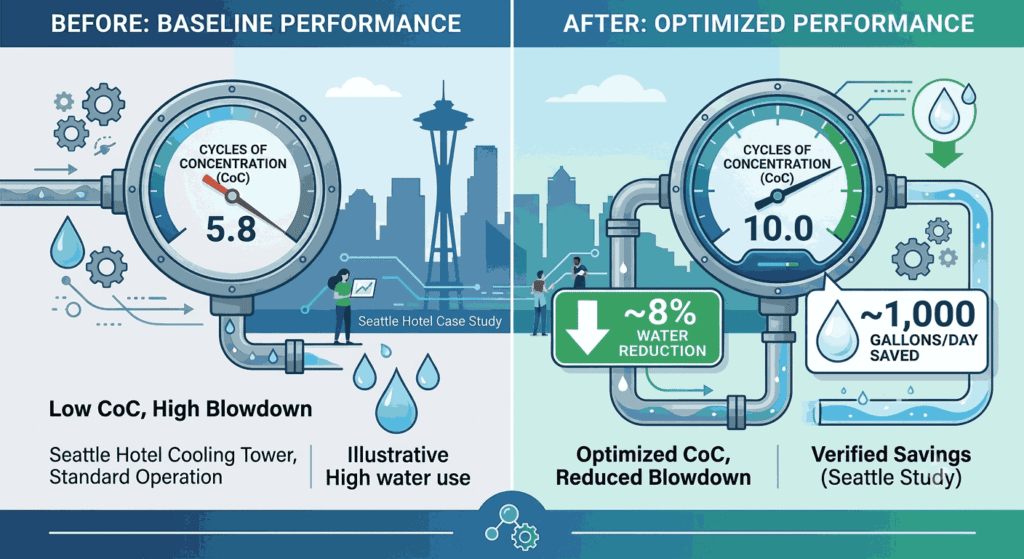
A water conservation demonstration study conducted for hotels in the Seattle area, prepared for Seattle Public Utilities, illustrates exactly how much is typically left on the table. Engineers sampling one hotel’s cooling tower found dissolved solids readings indicating a Cycle of Concentration (CoC) of just 5.8 — at the low end of acceptable operating range. The same study calculated that raising CoC from 5.8 to 10.0 would reduce cooling water use by roughly 8%, equivalent to approximately 1,000 gallons per day during peak season at that property alone. That’s not a hypothetical opportunity; it’s what a real hotel cooling tower was doing before anyone looked closely at the conductivity readings.
The Guest-Facing Half
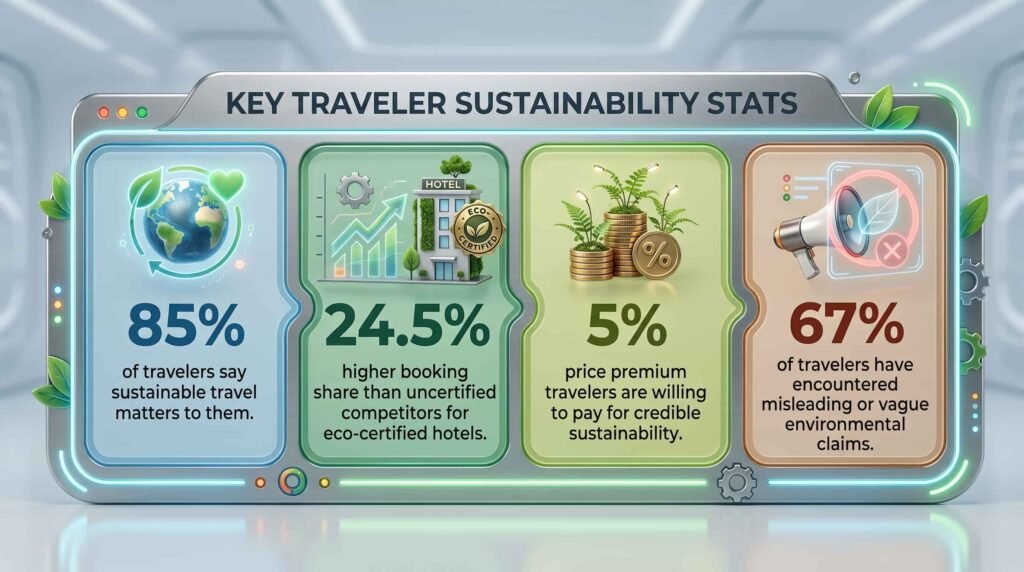
This is where hospitality genuinely differs from other verticals in this series. Booking.com’s 2026 Travel & Sustainability Report — its eleventh annual study, surveying 32,500 travelers across 35 markets — found that 85% of travelers say more sustainable travel is important or very important to them. That’s no longer a preference confined to one demographic: the report found that roughly one in three travelers across every generation surveyed — Gen Z, Millennials, Gen X, and Baby Boomers alike — plans to specifically book a sustainability-certified property in 2026, with intent levels the report describes as virtually identical across age groups. In 2025 alone, travelers booked more than 100 million room nights at Booking.com properties carrying a third-party sustainability certification.
The commercial impact isn’t just stated intent. According to Green Key Global 2025 data, eco-certified hotels saw a 24.5% increase in booking share compared to uncertified properties, and travelers reported willingness to pay a 5% premium to stay somewhere with credible environmental credentials.
There’s a credibility condition attached to all of this, worth taking seriously rather than glossing over: the same research environment found that 67% of travelers say they’ve encountered misleading environmental claims during a hotel stay. Vague sustainability language doesn’t just fail to help — it actively erodes trust once a guest notices the gap between the claim and what they actually observe. Specific, measurable claims perform differently than aspirational ones.
Where the Two Halves Actually Connect
This is the part worth building into how a hotel thinks about the investment, not just the messaging. The data that makes a water conservation project financially justifiable — metered savings, a documented CoC improvement, an actual percentage reduction in cooling tower water use — is the same data that makes a credible, specific guest-facing claim possible. A hotel that fixes its cooling tower’s Cycle of Concentration doesn’t just lower its water bill; it walks away with an exact, verifiable number it can put in front of a guest, a corporate travel program, or a certification assessor — precisely the kind of specific, dated, measurable claim that performs better than generic sustainability language, and the kind that doesn’t collapse under scrutiny the way 67% of hotel guests report vague claims already have.
Framed this way, the utility-cost case and the guest-facing case aren’t two separate initiatives competing for budget. They’re the same fix, generating two returns from one investment — which is a genuinely unusual position for a facilities project to be in.
What This Means in Practice
For hotel engineering teams, the practical question is close to the one raised throughout this series: is the property’s current cooling tower CoC based on a measured, current assessment of scaling risk, or a conservative setpoint nobody has revisited? Given that a real, documented case found a hotel cooling tower running at 5.8 when 10.0 was achievable, that question is worth asking directly rather than assuming the answer.
Non-chemical scale prevention technologies, including electromagnetic pulse-wave conditioning such as SWATS — built on electromagnetic field (EMF) technology — are engineered to remove the scaling constraint that typically holds CoC below what a water source could otherwise sustain, giving hotels room to capture both halves of this benefit rather than settling for whichever one gets noticed first.
Sources 🌐
- Fluence Corporation, How Hotels and Resorts Can Save More Water — source for the ~15% cooling tower share of total hotel water use: fluencecorp.com
- Seattle Public Utilities, Hotel Water Conservation demonstration report — source for the 5.8-to-10.0 CoC case study and the 8% cooling water savings finding: seattle.gov
- com, 2026 Travel & Sustainability Report — source for the 85% traveler sentiment figure, 100 million certified room nights, and the one-in-three cross-generational booking intent finding: news.booking.com
- Green Key Global 2025 data, as reported via Uniqode’s Sustainability in Hospitality industry report — source for the 24.5% booking share increase and 5% price premium findings, and the 67% misleading-claims statistic: keyt.com


