
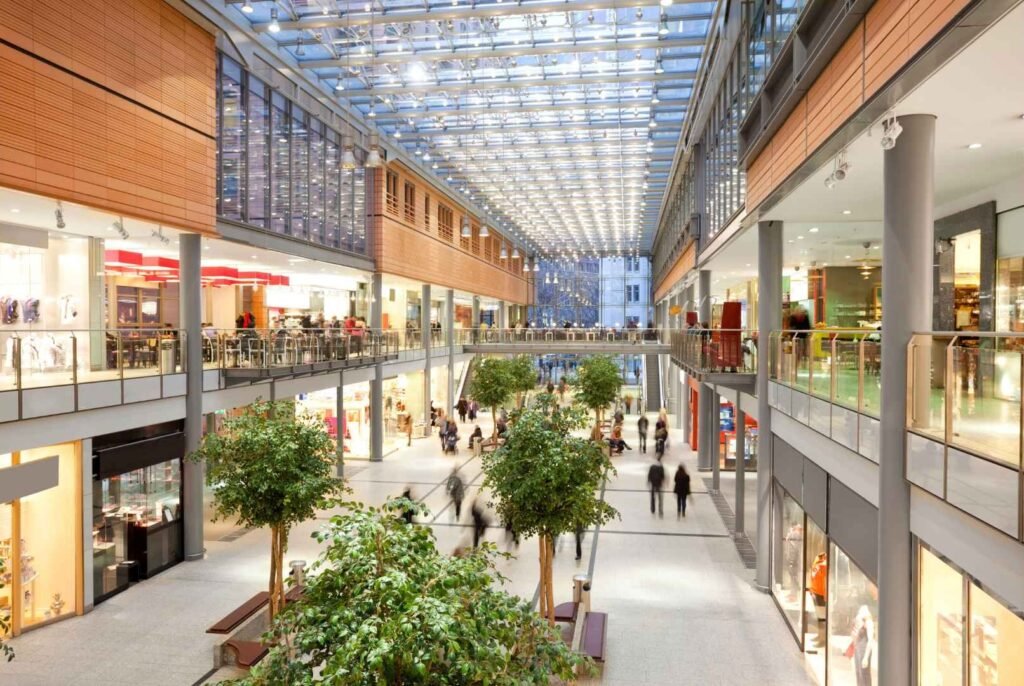
Why Mall Cooling Load Isn’t Evenly Distributed
Most of the verticals covered elsewhere in this series carry a roughly continuous cooling demand — a data centre runs at high load 24 hours a day regardless of the clock; a hospital’s critical care areas need constant climate control whether it’s 3pm or 3am. A mall’s demand curve looks nothing like that. It tracks opening hours, weekend traffic, and outdoor heat, which means the load is concentrated into a specific daily window rather than spread evenly across 24 hours.
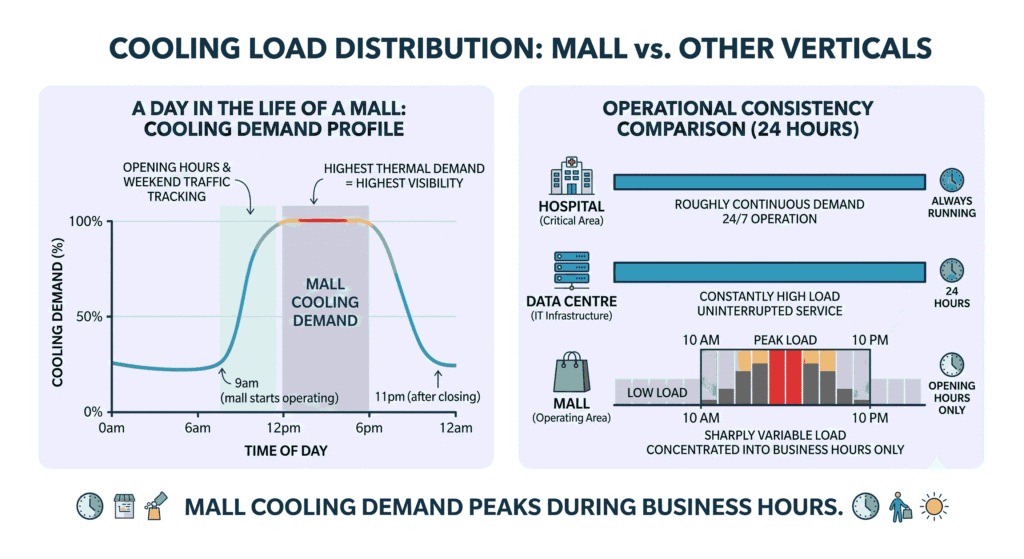
That concentration matters because it means the hours of highest thermal demand are the same hours as highest occupancy and highest visibility. A cooling shortfall at 3am in an empty mall is a non-event. The identical shortfall at 3pm on a Saturday, with the property full of shoppers and tenants trading, is an entirely different kind of problem.
The Flight-to-Comfort Effect: Why Heat Drives Foot Traffic, Not Away From It
There’s a counterintuitive finding worth knowing here. A 2024 peer-reviewed study in the Journal of Retailing and Consumer Services, analyzing a comprehensive credit card transaction dataset from brick-and-mortar stores in Seoul, Korea, found a significant increase in sales during extreme heat — approximately 4% higher during heatwaves exceeding 35°C. The researchers attribute this to a “thermal comfort hypothesis”: when outdoor conditions become genuinely uncomfortable, shoppers move toward air-conditioned indoor space rather than away from shopping altogether.
For a mall, that finding cuts in a specific direction. The hottest days — precisely when a cooling system is under the most thermal load and closest to its rated capacity — are also plausibly the days with elevated foot traffic, as shoppers seek exactly the kind of reliable indoor comfort a mall is built to provide. Seoul has hot, humid summers broadly comparable to Singapore in the months this effect would matter most, and in a market where malls function as genuine thermal refuges from tropical heat and humidity for most of the year, this dynamic plausibly holds with at least as much force. The result is a system facing its toughest thermal test at the same time it may be serving its highest customer volume — a double peak, not a single one.
Why Comfort Failure Is a Revenue Event, Not Just a Complaint
The link between cooling performance and retail revenue isn’t theoretical — it’s the direct implication of the Seoul finding above. When indoor comfort is reliably on offer and outdoor conditions are extreme, shoppers treat it as a reason to visit, stay, and buy. The inverse follows the same logic, even though it’s harder to isolate in a single dataset: a mall that fails to deliver on that comfort promise during the exact conditions that would otherwise drive shoppers in — because the chiller is straining rather than performing — has no basis to expect that sales lift, and risks the opposite outcome instead, with shoppers cutting a visit short rather than extending it. A cooling shortfall during peak hours isn’t just a complaint to property management. It undermines the specific condition — reliable indoor comfort — that the data shows shoppers are actively seeking out on exactly the days that matter most.
How Scale Turns a Slow Problem Into a Peak-Hour Failure
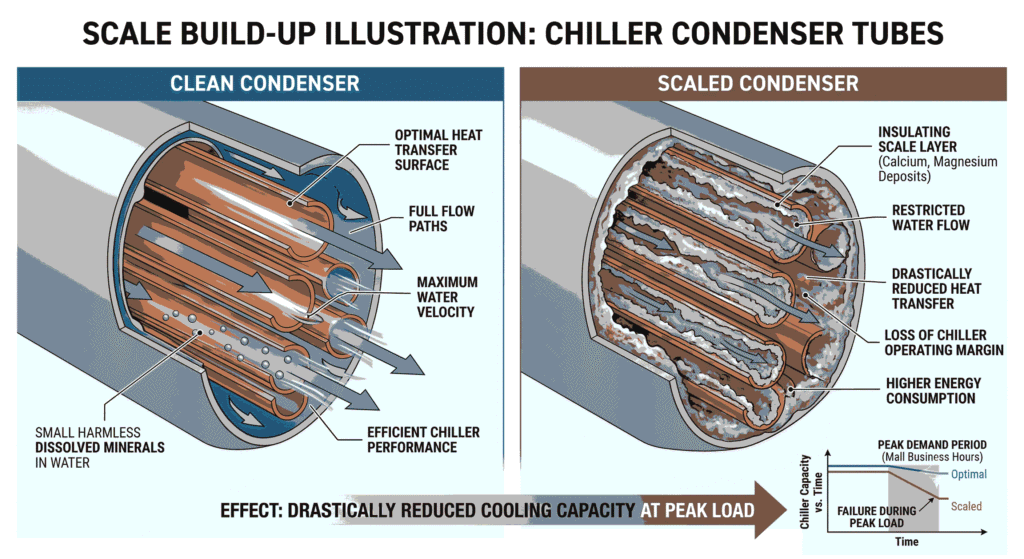
This connects to a mechanism covered elsewhere in this series: scale buildup inside a condenser loop doesn’t just raise energy costs gradually, it also narrows the operating margin a chiller has left before it can no longer keep up with demand. For a mall specifically, that narrowing margin matters most exactly at peak load — a system that’s quietly lost some efficiency to scale may still handle an ordinary Tuesday morning without issue, while falling short precisely on the hot Saturday afternoon when full rated capacity is actually required. The failure doesn’t show up during the easy hours. It shows up during the hard ones, which for a mall are also the highest-visibility, highest-revenue hours on the calendar.
What This Means for Mall Facilities Teams
This creates an unusually tight margin for error in both directions. The system needs to perform reliably at exactly the hours it can’t be taken offline for correction — a mall trading through peak weekend hours isn’t a good candidate for scheduled cooling plant downtime any more than a hospital or data centre is, even though the underlying reason differs. That makes installation profile as important as the underlying fix: a scale management approach that requires cutting into pipework or stopping the system to install isn’t a realistic option for a property that can’t schedule around its own busiest hours.
Non-chemical scale prevention technologies, including electromagnetic field (EMF) technology such as SWATS are engineered around a solenoid coil, zero-downtime installation profile specifically because of constraints like this: restoring a chiller to its design efficiency without requiring the property to close, or the cooling plant to go offline, to get there.
Sources 🌐
- Yoo, J., Eom, J., & Zhou, Y. (2024), Thermal comfort and retail sales: A big data analysis of extreme temperature’s impact on brick-and-mortar stores, Journal of Retailing and Consumer Services, Vol. 77, Elsevier — source for the ~4% sales increase during heatwaves exceeding 35°C in Seoul, Korea: doi.org


