

What “Net Zero” Actually Requires
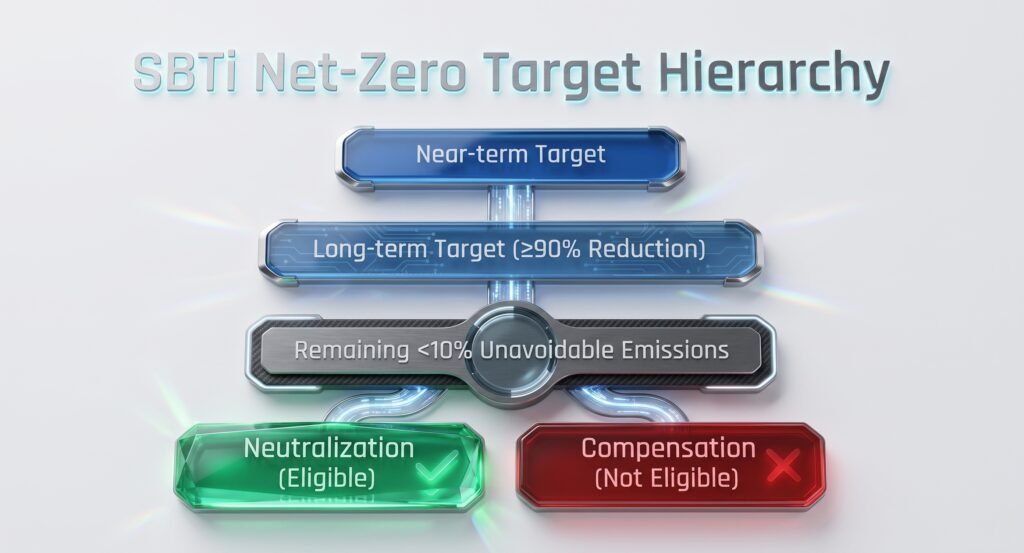
The Science Based Targets initiative (SBTi) sets the leading framework for corporate net-zero target-setting, translating the Paris Agreement’s 1.5°C goal into a specific corporate methodology. Under SBTi’s Corporate Net-Zero Standard, a company sets two targets: a near-term target covering a 5–10 year window, and a long-term target requiring at least 90% absolute emissions reduction across Scope 1, 2, and 3 by 2050 at the latest.
The part of the standard that matters most for this discussion is what happens to the remaining, unavoidable share — typically under 10% of a company’s baseline emissions. SBTi draws a strict distinction between two very different-sounding actions: neutralization, the permanent removal and storage of greenhouse gases to counterbalance genuinely residual emissions, and compensation, the use of avoided-emissions offset credits to claim an unabated tonne has been cancelled out. Only neutralization, using permanent removals, is eligible once a company reaches its net-zero target year. Compensation — standard carbon offsetting — is explicitly not eligible to count toward progress on either the near-term or long-term reduction target.
Why This Puts “Reduce” Actions in a Different Category Than Offsets
This distinction is what gives cooling efficiency its actual standing in a net-zero strategy. A verified reduction in chiller energy consumption isn’t a workaround or a supplementary gesture — it’s a direct contribution to the 90% reduction figure the entire framework is built around. Carbon credits, by contrast, cannot be used to demonstrate progress against that same target at all, regardless of how many a company purchases.
That reframes what a chiller efficiency project actually represents in a net-zero disclosure. It isn’t a nice-to-have sustainability initiative sitting alongside the “real” net-zero work of offsetting. Under the standard most companies are now assessed against, it’s a more credible category of action than offsetting is — because it’s one of the only categories that counts toward the target at all.
Where Cooling Efficiency Sits — and Where It Doesn’t
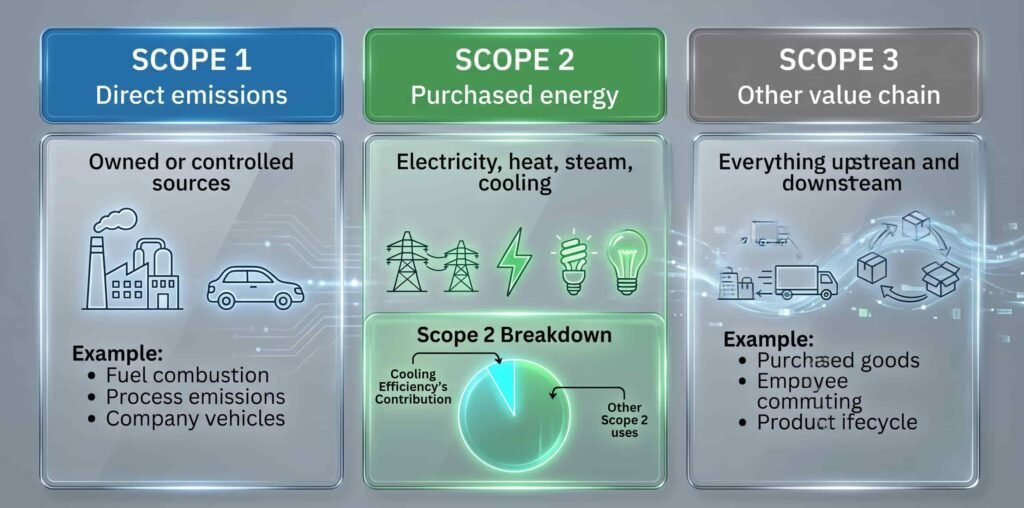
Honesty matters here as much as the framing above. Cooling is typically the single largest energy load in a commercial or industrial facility, which makes efficiency gains here a genuinely material Scope 2 lever — not a token one. But a chiller retrofit is still one lever within a target that spans a company’s entire value chain: direct emissions from owned operations (Scope 1), purchased energy (Scope 2), and everything upstream and downstream in the supply chain (Scope 3). A 90% reduction target isn’t achieved by any single facility upgrade, however material.
A net-zero claim built on a cooling efficiency project alone would be overstating the case. The honest framing is narrower and, frankly, more defensible: cooling efficiency is a real, quantifiable, credited contribution to a company’s Scope 2 reduction trajectory — sized accurately to what it actually delivers, not extrapolated into a claim about the whole target.
The Supply Chain Angle Most Net-Zero Roadmaps Miss
Everything discussed so far concerns Scope 2 — the electricity a chiller consumes. There’s a second, less obvious angle tied to how a facility treats its cooling water in the first place. Chemical water treatment programs require ongoing consumables: chemicals that are manufactured, packaged, and transported to site on a recurring basis. That’s a genuine emissions source sitting in Scope 3 — purchased goods and services, and the transportation that delivers them — even though it’s rarely broken out as its own tracked line item in most companies’ Scope 3 inventories.
Electromagnetic scale prevention doesn’t require a facility to eliminate chemical treatment entirely to see a benefit here. Because it handles scale control directly, it typically allows a facility to run a lighter, scoped-down chemical program focused only on corrosion and biological control — meaning less consumable volume manufactured, packaged, and transported on an ongoing basis, even without going fully chemical-free. To be clear about scale: for most companies, water treatment chemical procurement is a small fraction of total Scope 3 emissions, not a headline number. But in a framework where every genuine reduction counts toward a strict 90% target, a recurring input reduced is worth accounting for accurately rather than leaving untracked.
Building This Into a Net-Zero Roadmap Honestly
The practical takeaway for an ESG team is less about the technology and more about how it gets characterized. A cooling efficiency project belongs in a net-zero disclosure as a specific, quantified reduction — calculated using the same rigor as any other Scope 2 figure — not as a standalone net-zero claim, and not blended together with offset-based compensation as though they carry equal weight. They don’t, under the standard that actually governs how these claims get assessed.
HannveTech’s SWATS solution — built on electromagnetic field (EMF) technology — is engineered specifically around the Scope 2 reduction lever this piece is about: restoring a chiller to its design efficiency, which translates directly into the kind of verified, creditable reduction a net-zero roadmap actually requires. Paired with a lighter chemical program for corrosion and biological control, it also curbs the recurring consumable footprint discussed above — a real, if secondary, benefit layered on top of the core energy case.
Sources 🌐
- Science Based Targets initiative (SBTi), Corporate Net-Zero Standard, Version 1.3.1 (April 2026, current effective version) — source for the 90% absolute reduction requirement and the near-term/long-term target structure: sciencebasedtargets.org
- SBTi, Net-Zero Jargon Buster — source for the neutralization vs. compensation distinction: sciencebasedtargets.org


